Poetry
Instructional ideas & resources
Overview
- Introduction
- Elements of poetry
- Pictorial & textual enhanced poem!
- Quality characteristics of poems
- Suggested questions to analyze poetry quality
- Some children's thoughts about poetry
- Instructional ideas
- Poem and choral reading samples
- Choral readings
- Poets & poems readers & listeners enjoy!
- Poets
- Paired picture books & poetry
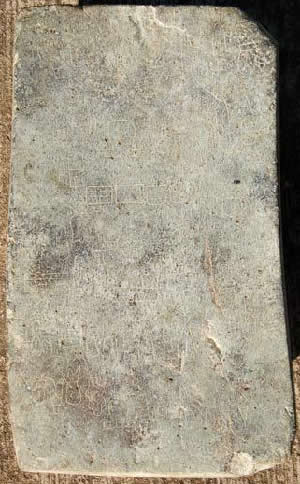
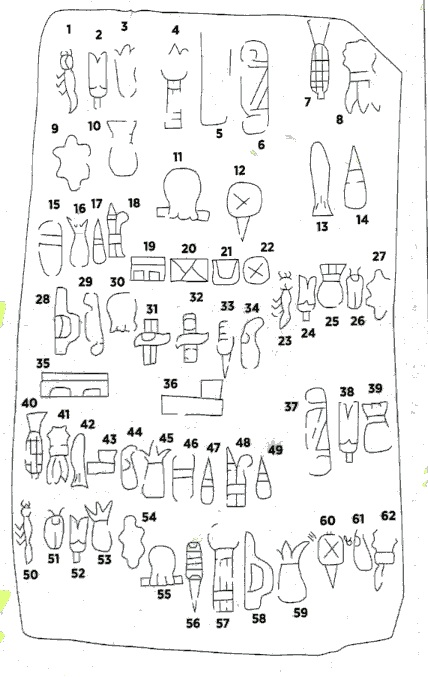
- First poem in the Americas?
- Checklist for Analyzing Poetry
- Writing Limericks - Instructional plan & suggestions
- Walk Two Moons poem analysis
You can find poetry in your everyday life, your memory, in what people say on the bus, in the news, or just what's in your heart.
Introduction
This page includes a description of poetry, its elements, quality characteristics, suggested questions to help analyze its quality, instructional suggestions, links to sample quality poems to introduce to learners, sample choral readings, finger plays, writing limericks instructional plan & suggestions, paired pictue books and poetry, and maybe the first poem in the Americas.
Poetry is a genre of literature with an intense emotional expression with a distinct style and rhythm of verse that can be analyzed by the poetic elements.
Genre related to poetry includes nursery rhymes, ballads, epics, songs, poems, and lyrics.
Elements of Poetry
Poetry has an overall central theme or idea within each poem. Other elements include:
- Images - the mental pictures the poet creates through language.
- Diction - the selection of specific words.
Form - the arrangement of words, lines, verses, rhymes, and other features. - Cadence - A rhythmic change in the inflection of sounds from words being spoken. Sometimes referred to the flow of words.
- Couplet - two lines of verse that rhyme at the end and are thought as one unit.
- Meter - A rhythm that continuously repeats a single basic pattern.
- Rhyme - Words that end with similar sounds. Usually at the end of a line of the poem.
- Rhyming - Two lines of a poem together with the same rhythm.
- Rhythm - A pattern created with sounds: hard - soft, long - short, bouncy, quiet - loud, weak - strong.
- Stanza - A part of a poem with similar rhythm and rhyme that will usually repeat later in the poem.
- Verse - A line of a poem, or a group of lines within a long poem.
Quality Characterisics of poems
- Imaginative
- Creative
- Descriptive and vivid language that often has an economical or condensed use of words chosen for their sound and meaning
- Meaning is enhanced by recalling memories of related experiences in the reader or listener
- Provokes thought
- Causes an emotional response: laughter, happy, sad …
- Uses figurative language (personification, similies, methaphors...)
- Imagery where the reader/listener creates vivid mental images
- Often has rhythm and rhyme
- Often includes words and phrases that have a pattern made with rhythm and rhyme.
- Story in verse
- Can have physical and grammatical arrangement of words usually enhance the reader's overall experience
Questions to ask to analyze & evaluate the quality of poetry
- Does it have figurative language and imagery?
- Does it create images? (pictures, sounds, smells, tastes, touching sensations)
- Is what the author says or doesn’t say helpful in creating imagery?
- Does it move from the familiar to the unfamiliar or unfamiliar to familiar in a manner that enlightens and/or amazes?
- Is it understandable? (literally, interpretively, and emotionally) Alone or with help?
- Does it appeal to me? To who else would it appeal?
- Does the poem touch people emotionally?
- Are words combined in a mixture that communicates both a literal and suggested meaning.
- Not so precise as to limit the imagination or so suggestive as to not communicate? (denotation and connotation).
- Does it get to the heart of an idea?
- Is it creative with language? Use language and words in interesting ways? (metaphors, similes, personifications).
- Are words used in a highly powerful manner? Is there a lot of zap with few words?
- Is it a language of simplicity?
- Does it sing to you? [sounds (alliteration, assonance, onomatopoeia), verse, rhythm, patterns, beat (words, phrases), rhyme (end of line, inline, and/or link rhyme)
- Does it include ideas that people can use?
Some children's thoughts about poetry
Children like to write poetry because they
- feel there are no limitations
- can be creative without taking risks
- don't need to worry about conventions (punctuation, complete sentences).
Children might not like to write poetry because they
- don't like to struggle with word choices
- don't like the struggle with a desire to be original
- don't want to risk creating something someone might not like
- don't have strategies to help be creative
- struggle with words (spelling, vocabulary, small repetooire of words)
- desire to have it rhyme, have rhythm,and/or a melody
Instructional ideas
A fairly easy instructional strategy to use with a poem is to read a poem and ask students to answer four questions, individually, in a group, or as a class:
- What do you think the poet was trying to share by writing the poem?
- What emotions are felt when the poem is read?
- What are three key words, phrases, or ideas in the poem. Be ready to explain why you believe your choices are key.
- Use your three words, phrases, or ideas to write a summary about the poem.
- Checklist to evaluate good poems
- Limirick introductory sequence
- Walk Two Moons and activity for Longfellows poem
- Make poem collection - sample poem collection
Poem Samples
- My poem book collection - 26 assorted poems I illustrated for school assignment plus Archimedes ...
- Attitude & Life - Charles Swindoll
- The Butterfly's Ball and the Grasshopper's Feast - William Roscoe (1807)
- Crocodile - unknown
- Over in the Meadow - Olive A. Wadsworth (Katherine Floyd Dana) First published: 1870
- Rose - Galloway
- Song lyrics: Breakaway - Kelly Clarkson
- Snowy Evening - Robert Frost
- Valentines day assorted poems
- We & They
A Pictorial & Textual Enhanced Poem!
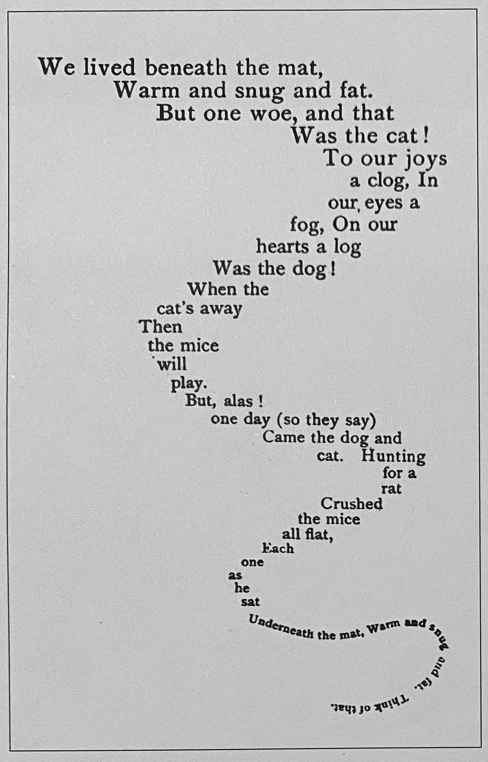
The Mouse's Tale
by Lewis Carroll - 1865
Choral reading samples
- Fireflies
- Jack's House
- Three Little Pigs Read Aloud or Sing Along or Chant Along. Mother Goose related
- Whirlygigs
Poets and poems readers & listeners enjoy!
My peotry collection ebook!
| Poet | Poem |
|---|---|
| Baylor, Byrd | If You Are A Hunter Of Fossils |
| Christelow, Eileen | Five Little Monkeys Jumping on the Bed |
| Degen, Bruce | Jamberry |
| DePaola, Tomi | Tomie DePaola's Book of Poems |
| Fleischman, Paul | Joyful Noise I Am Phoenix. |
| Frost, Robert | You Come Too |
| Gerrard, M. A. Benante, & A. Lavigne | Breakaway - kelly clarson |
| Grimes, Nikki | Meet Danitra Brown Bronx Masquerade - story and poems |
| Hopkins, Lee Bennett | Good Books Good Times Pterodactyls and Pizza. |
| Leech, Bryan Jeffery | John Jeremy Colton |
| Lillegard, Dee | September to September |
| Martin, Bill Jr | Brown Bear Brown Bear, What Do You See? |
| Martin, Bill Jr. and J Archambault | Chicka Chicka Boom Boom |
| O'neill, Mary | Hailstones and Halibut Bones. |
| Prelutsky, Jack | Random House Book of Poetry for Children. Ill. Arnold Lobel Something BIG Has Been Here |
| Schenk de Regniers, Beatrice, and others | Sing a Song of Popcorn Illustrations by nine Caldecott Medal artists |
| Segger, Pete | Abiyoyo |
| Silverstein, Shel | Where the Sidewalk Ends |
| Simon, Carly | The Fisherman's Song |
| Westcott, Nadine Bernard | Peanut Butter and Jelly |
Poets
| A. A. Milne | Aileen Fisher | Badger Clark |
| Carl Sandburg | Christine Rossetti | Conrad Aiken |
| David McCord | Dorothy Baruch | Eleanor Farjeon |
| Edna St. Vincent Millay | Edward Lear | Emily Dickenson |
| Elizabeth Coatsworth | Elizabeth Madox Roberts | Hans Christian Andersen |
| Eugene Field | Eve Merriam | Hilda Conkling |
| Harry Behn | Henry Wadsworth Longfellow | John Ciardi |
| James Tippett | Joan Walsh Anglund | Kate Greenaway |
| Karla Kuskin | Kate Cox Gossard | Leland B. Jaacobs |
| Langston Hughes | Laura Richards | Lord Alfred Tennyson |
| Lewis Carroll | Lilian Moore | Mary O’Neill |
| Marie Louise Allen | Mary Austin | Nancy Byrd Turner |
| Monica Shannon | Myra Cohn Livingston | Pauline C. Peck |
| Noah Smaridge | Ogden Nash | Robert Browning |
| Rachel Field | Raoph Waldo Emerson | Rose Fyleman |
| Robert Frost | Robert Louis Stevenson | Shel Silversten |
| Rosemary and Stephen Vincent Binet | Sara Teasedale | Walter de la Mare |
| Vachel Lindsay | Walt Whitman | |
| William Blake | ||
Pairing Picturebooks and Poetry around science topics
Pairing text - defined, rational, and benefits
Paired texts is when two different texts, related in some way, are used by learners. Either instructionally or self selected.
The instructional idea is based on the ideas that reading comprehension and learning makes connections from past experiences to current experiences. Hence, pairing text provides an expectation that ideas will be connected and strategies to develop productive thinking, comprehending, and learning will more likely be used.
Texts that are paired, have complementary information, but are different in some manner. They can be: enriched with additional information, or have contradictory information, or have unique situations or perspectives.
These experience can enable learners to relate information from one text to another in a way to connect information to enrich their experiences with additional information. Information that may be from different genres or perspectives interpreted or communicated in different ways, extend the use of vocabularly by applying the same words in different contexts, and increasing motivation as they become familiar with a topic and desire to explore it more.
The following list is reprinted from Pairing Picturebooks and Poetry to Teach Science and Scientists Behind the Science. William P. Bint. Science and Children. May/June 2026.
| Disciplinary core ideas | Picturebook | Poetry |
|---|---|---|
| Scientists | Star Stuff: Carl Sagan and the Mysteries of the Cosmos(Sisson, 2014) | A Brave and Startling Truth (Jarrell, 2023). |
| Isaac Newton and the Laws of Motion (Dolz, 2020) | Gravity (physics) Poem (Mr. R.'s, 2023) | |
| Newton and Me (Mayer, 2013) | The Tree of Knowledge (Winstanley, 2023) | |
| Mr. Archimedes Bath (Allen, 2001) | Archimedes' Principle (Marine, 2023) | |
| The Watcher (Winter, 2011) | The Caring Primate Jane Goodall (Charles, 2023) | |
| Snowflake Bentley (Martin, 2009) | Snowflake (McCord, in Hopkins, 1999) | |
| The Water Lady: How Darlene Arviso Helps a Thirsty Navajo Nation (McGinty, 2021) | Cool Clear Water (Saywell, 2023) | |
| Neo Leo: The Ageless Ideas of Leonardo da Vinci (Barretta, 2009) | Da Vinci Did It! (LaTulippe, 2014) | |
| From Molecules to Organisms: Structures and Processes | The Emperor's Egg (Jenkins, 1999) | If I Were an Egg (Sidman, 2000) |
| First the Egg (Seeger, 2007) | If I Were an Egg (Sidman, 2000) | |
| The Emporer Lays an Egg (Cuiberson, 2001) | Mr. Penguin (Javabookworm, 2023) | |
| Condor's Egg (London, 1994) | For the California Condor (Myers, 2023) | |
| Honeybee: The Busy Life of Apis Mellifera (Fleming, 2020) | Honeybees (Fleischman, 1988) | |
| The Ugly Butterfly: An Imaginative Story about the Life Cycle of a Caterpillar (Espinoza, 2021) | What Will I Grow Up To Be? (In Raines, 2022) | |
| The Bizarre Life Cycle of a Mayfly (Roza, 2012) | May Fly (Hoberman, 2006) | |
| The Tiny Seed (Carle, 2005) | The Seed (Fisher, in Hopkins, 2002) | |
| The Life Cycle of an Emperor Penguin (Kalman, 2006) | Dark Emperor (Sidman, 2010) | |
| And the Bullfrogs Sing: A Life Cycle Begins (Harrison, 2020) | Bull Frog (Lewis, 1998) | |
| Spring Peepers are Calling (Billings, 1978) | Listen For Me (Sidman, 2005) | |
| All About Turtles (Arnosky, 2000) | The Little Turtle (Lindsay, 2023) | |
| Stellaluna (Cannon, 2018) | A Bat is Born (Jarrell, 2023) | |
| Moth & Butterfly: Ta Da! (Petty, 2021) | Changes (Scieszka & Smith, 2004) | |
| The Very Impatient Caterpillar (Burach, 2019) | Conversation on a Leaf (Lewis, 2005) | |
| Waiting for Wings (Ehlert, 2001) | Metamorphosis (Lynn, 2023) | |
| Farfallina & Marcel (Keller, 2002) | Chrysalis Diary (Fleischman, 1988) | |
| Caterpillar's Journey to Metamorphosis (Padmini, 2021) | Meta-Meta-Morphosis (In Raines, 2022) | |
| Gotta Go! Gotta Go! (Swope, 2000) | Mystical Migration of the Monarch Butterflies (Sunprincess, 2023) | |
| The Peregrine's Journey: A Story of Migration (Dunphy, 2008) | Egg Business (Sidman, 2000) | |
| The Very Impatient Caterpillar (Burach, 2019) | Metamorphosis (Sandburg, in Hopkins, 2002) | |
| Caterpillar to Butterfly (Marsh, 2012) | Caterpillar No More (In Raines, 2022) | |
| Why the Butterfly: Why do Seasons and Weather Change (Recao, 2021) | Life Like a Butterfly (Pulsifer, 2023) | |
| Monarch Butterfly (Gibbons, 1989) | Monarch Butterfly Poem 1 (Brown, 2023) | |
| Monarch Butterflies: Mysterious Travelers (Lavies, 1992) | Butterfly (Peterzell, 2023) | |
| Monarch Butterfly of Aster Way (Ring, 1999) | The Monarch Butterfly (Lianna, 2022) | |
| Food Chain (Robertson, 2009) | Food Chain (Mr. R.'s, 2023) | |
| Dory Story (Pallotta, 2000) | Food Chain (Scieszka & Smith, 2004) | |
| Pass the Energy, Please! (McKinney, 2000) | Food Chain (Scieszka & Smith, 2004) | |
| Diary of a Worm (Cronin, 2003) | Ode to an Earthworm (Lamp'l, 2023) | |
| Flight of the Honey Bee (Huber, 2013) | Summer Hummer (Florian, 2012) | |
| Bear Snores On (Wilson, 2002) | Bubba Bear's Cozy Hibernation Haven (Kruttsinger, 2023) | |
| Earth's Systems | A Drop Around the World (McKinney, 1998) | Water Cycle (Scieszka & Smith, 2004) |
| A Drop Around the World (McKinney, 1998) | A Water Drop's Adventure (Martin, 2023) | |
| Water Dance (Locker, 2002) | Water, the Life-giving Stream: A Journey of Change (Biopatrika, 2023) | |
| Drop: An Adventure through the Water Cycle (Moon, 2021) | Water Cycle (Scieszka & Smith, 2004) | |
| Air Is All Around You (Branley, 1986) | Air is… (Chance, 2023) | |
| Drop: An Adventure through the Water Cycle (Moon, 2021) | Water Cycle (Riley, n.d.) | |
| Water is Water: A Book about the Water Cycle (Paul, 2015) | Water Cycle Poem (Mr. R.'s, 2023) | |
| The Incredible Water Show (Frasier, 2004) | Water Cycle (Riley, n.d.) | |
| The Incredible Water Show (Frasier, 2004) | Water Cycle (Scieszka & Smith, 2004) | |
| When Cloud Became a Cloud (Hodgson, 2021) | Water Cycle Poem (Mr. R.'s, 2023) | |
| Water is Water: A Book about the Water Cycle (Paul, 2015) | Water Cycle Poem (Mr. R.'s, 2023) | |
| Earth's Place in the Universe | Astronomy for Beginners: A Young Stargazers Guide to the Universe (Baby Professor, 2016) | When I Heard the Learn'd Astronomer (Whitman & Long, 2004) |
| Our Solar System (Simon, 2014) | Astronaut Stopping by a Planet on a Snowy Evening (Scieszka & Smith, 2004) | |
| If You Decide to Go to the Moon (McNulty, 2005) | Let's All Go to The Moon (Storyberries, 2023) | |
| Space Skunks: A Children's Book about Saving Earth (Potler, 2020) | Walk Lightly (Lewis, 2002) | |
| Planet Earth/Inside Out (Gibbons, 1995) | Earth (Planet) Poem (Mr. R.'s, 2023) | |
| The Planets in our Solar System (Branley, 1987) | Our Solar System Poem (Aunt Mary, 2023) | |
| From Here to There (Cuyler, 1999) | Astro Cow (Nesbitt, 2023) | |
| Biological Evolution | My Five Senses (Aliki, 2015) | The Senseless Lab of Professor Revere (Scieszka & Smith, 2004) |
| Evolution: The Story of How Life Developed on Earth (Cole, 1987) | You're Not So Great (Chiykowski, 2023) | |
| My First Book about the Five Senses (Wynne, 2017) | SENSES (Silverstein, 1981) | |
| The Bones You Own (Baines, 2009) | Human Bones Poem (Mr. R.'s, 2023) | |
| Give Me Back My Bones! (Norman, 2019) | Boneless (Wolf, 2003) | |
| Ecological Systems | Over and Under the Snow (Messner, 2014) | Talking in Their Sleep (Thomas, 2023) |
| Up in the Garden and Down in the Dirt (Messner, 2017) | Life of a Plant (Jordan, 2023) | |
| Over and Under the Waves (Messner, 2022) | Ocean â€" A Short Poem (Shahzad, 2023) | |
| If You Take Away the Otter (Buhrman-Deever, 2020) | Cry of the Wild (Smith, 2002) | |
| Force and Motion | The Power of the Wind Harvested (Baby Professor, 2017) | What Are You, Wind (O'Neill, in Hopkins, 1999) |
| Motion: Push and Pull, Fast and Slow (Stille, 2004) | The Acrobats (Silverstein, 2014) | |
| What Makes a Magnet? (Branley, 1996) | Magnet (Worth, in Hopkins, 2002) | |
| Magnets Push, Magnets Pull (Adler, 2018) | Magnet (Worth, in Hopkins, 2002) | |
| Forces Make Things Move (Bradley, 2005) | Force (physics) Poem (Mr. R.'s, 2023) | |
| Matter and Its Interactions | Let's Get Moving: Speeding Into the Science of Motion with Newtonian Physics (Ferrie, 2018) | Laying Down the Laws of Motion (Mondak, 2023) |
| What's the Matter in Mr. Whisker's Room? (Ross, 2007) | What's the Matter? (Scieszka & Smith, 2004) | |
| Matter: Physical Science for Kids (Diehn, 2018) | What's the Matter (Scieszka & Smith, 2004) | |
| Matter: See It, Touch It, Taste It, Smell It (Stille, 2004) | Solid, Liquid, Gas (Author Unknown, 2023) | |
| What Is The World Made Of?: All About Solids, Liquids, and Gases (Zoehfeld, 1998) | Matter Really Matters (Boulais, 2023) | |
| All about Matter (Schuh, 2011) | What is Matter (Author Unknown, 2023) | |
| Matter (Squire, 2019) | Matter Always Matters (Rosenbaum, 2023) | |
| Matter (Dunne, 2016) | Matter Really Matters (Author Unknown, 2023) | |
| The Solid Truth about Matter (Weakland, 2012) | Magic Water (Author Unknown, 2023) | |
| Matter (Squire, 2019) | What's the Matter? (McGowen, 2023) |
Early writing in America 900 BCE
Maybe first American poem... It is thought to be a poem as the images repeat in a pattern similar to the pattern of Mesoamerican poetic couplets. Scientific American July 2015
Checklist for Analyzing Poetry
Evaluator:
|
yes no | Supporting evidence |
|---|---|---|
| Does it have figurative language and imagery? | ▢ yes ▢ no |
|
| Does it create images? (pictures, sounds, smells, tastes, touching sensations) | ▢ yes ▢ no |
|
| Is what the author says or doesn’t say helpful in creating imagery? | ▢ yes ▢ no |
|
| Does it move from the familiar to the unfamiliar or unfamiliar to familiar in a manner that enlightens and/or amazes? | ▢ yes ▢ no |
|
| Is it understandable? (literally, interpretively, and emotionally) Alone or with help? | ▢ yes ▢ no |
|
| Does it appeal to me? To who else would it appeal? | ▢ yes ▢ no |
|
| Does the poem touch people emotionally? | ▢ yes ▢ no |
|
| Are words combined in a mixture that communicates both a literal and suggested meaning. Not so precise as to limit the imagination or so suggestive as to not communicate? (denotation and connotation). | ▢ yes ▢ no |
|
| Does it get to the heart of an idea? | ▢ yes ▢ no |
|
| Is it creative with language? Use language and words in interesting ways? (metaphors, similes, personifications). | ▢ yes ▢ no |
|
| Are words used in a highly powerful manner? Is there a lot of zap with few words? | ▢ yes ▢ no |
|
| Is it a language of simplicity? | ▢ yes ▢ no |
|
| Does it sing to you? [sounds (alliteration, assonance, onomatopoeia), verse, rhythm, patterns, beat (words, phrases), rhyme (end of line, inline, and/or link rhyme)] | ▢ yes ▢ no |
|
| Does it include ideas that people can use? | ▢ yes ▢ no |
|
Writing Limericks - Instructional plan & suggestions
Sample
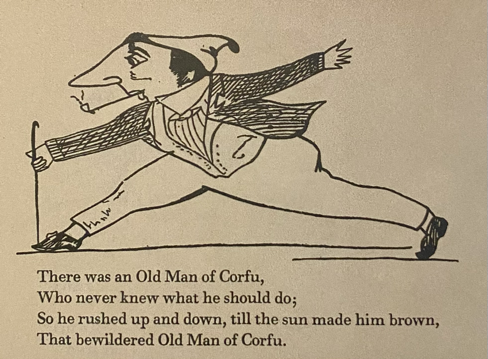
Limerick by Edward Lear - 1846
with a simple line drawing to to match the limerick's humor.
Outcomes
- Literature
- Identify Limerick as a genre.
- Know it as a subcategory of poetry.
- Writing
- Write and review vocabulary.
- Recognize as short writing.
- Use words to communicate a message.
- Recognize Limerick as a form of poetry.
- Word Study
- Develop language acquisition skills with the use of a dictionary, thesaurus, or internet search.
- Use words from oral vocabulary and personal lists.
- Reading
- Read fluently.
- Comprehend the meaning fo a Limerick.
- Speaking
- Recite limericks
- Read poems
- Visualization
- Create pictures or compose photographs to communicate a message .
- Creative thinking and responding
- Discover patterns of the limerick genre.
- Brainstorming ideas for a limerick.
- List rhyming words.
- Brainstorm and select meaningful powerful words to include in their writing that comunicate their ideas accurately and powerfully.
- Creative writing
- Write poetry as limericks.
- Media Literacy
- Compose limericks with text, illustrate limericks with digital pictures or art, and record recitations and combine these pieces into a multimedia collection.
- Compose limericks with text, illustrate limericks with digital pictures or art, and record recitations and combine these pieces into a multimedia collection.
- Critical Literacy/Listening and Thinking Skills
- Share their multimedia produced limerick collection with the class, listen, and share positive critical feedback.
Background information to facilitate learning / implement limerick instruction
Limerick Genre Pattern - printable fact sheet.
Limericks
- A limerick usually has 5 lines,
- With a rhythm of two short or unaccented followed by one long or accented syllables (anapestic),
- Where lines 1, 2, and 5 rhyme , and lines 3 and 4 rhyme , and
- Usually written in the past tense.
Can be thought of as:
da DUM da da DUM da da DUM
da DUM da da DUM da da DUM
da DUM da da DUM
da da DUM da da DUM
da DUM da da DUM da da DUM
Limerick Sample with rhyming lines color coded
And syllables separated to show the rhythm.
There was a young girl by the sea.
Who per formed a re mark a ble curt sy;
She twirled round and round,
Till she spun under ground.
Which dis tressed eve ry one who could see.
A framework may help to get started writing your limerick!
Framework number one
There once was a __________ from___________.
Who was __________ and (past tense verb) ____________________.
When __________________________________.
He or she replied ____________________________________.
That ____________ from ___________________.
Framework number two
I once met a _______________ from ____________.
Everyday s/he ________________ and _______________.
But whenever s/he _______________.
The ___________________________ _____________.
That ________________________ from _______________.
Focus Questions
- What is poetry?
- What is a limerick?
- What do you notice about this poem?
- What words can you think of that describe places?
- How many words can you think of that rhyme with those places?
- How could you create a Limerick or poem about a place?
Vocabulary - depends on Limerick or what might want it to include.
Evaluation criteria see the checklist for analyzing poetry ...
Instructional Procedure
- Read aloud - a few Limericks as a hook. Could use selections - online source such as - Poetry-online.org or selections in Isaac Asimov’s Limericks for Children.
- Give or have learners find a written limerick and have them determine what they think the rules of Limerick writing are.
- Assistance may be offered by providing all or parts of a framework to assist their writing.
- Skip to #4 ...
Optional Procedure:
- Have students brainstorm and write two or three places they have or would like to live or visit.
- Have them choose 2 places from their list that have rhymes or they may want to select additional places.
- Continue by having them brainstorm rhyming words for their locations and write them underneath the place names. Encourage listing words that provide colorful descriptions or that describe a particular aspect of that place. May want to make a rhyming word wall or add them to current word wall or journal...
- Skip to #4 ...
End of optional ---
- Students can use what they discovered about the pattern of a Limerick to create their own Limerick.
Pattern - usually 5 lines, with a rhythm of two short or unaccepted followed by one long or accented syllables (anapestic), where lines 1,2 and 5 rhyme, and lines 3 and 4 rhyme, and usually written in the past tense. - Suggest they create their own limericks.
- Learners brainstorm ideas alone or in pairs or small groups for their own limerick.
- Have students use their limerick to create a multimedia presentation with a written and oral form of their limerick that they read, record, and illustrate as a digital multimedia photo story gallery.
Walk Two Moons - Longfellow Poem analysis
Also - Journal suggestions

The Tide Rises, the Tide Falls;
The tide rises, the tide falls,
The twilight darkens, the curlew calls,
Along the sea-sands damp and brown,
And the tide rises, the tide falls.
Darkness settles on roofs and walls,
But the sea, the sea in the darkness calls,
The little waves, with their soft, white hands,
Efface the footprints in the sands,
And the tide rises, the tide falls.
The morning breaks; the steeds in their stalls
Stamp and neigh, as the hostler calls,
The day returns, but nevermore
Returns the traveler to the shore,
And the tide rises, the tide falls.
- Describe your personal reaction to this poem ... What does it say to you?
- Form a literature circle and reflect, discuss, and document your collective responses to the following questions. (Each member make a copy of the responses on a sheet of notebook paper to put in your portfolio.)
- Why does this poem disturb Sal so much?
- How was Sal's mother a traveler?
- What is the shore?
- Why the repetition of the phrase, The tide rises, the tide falls?
- How is Sal a traveler?
- What is she looking for?
- Literature home
- HoB home