Teacher Notes for Forty Squares puzzle
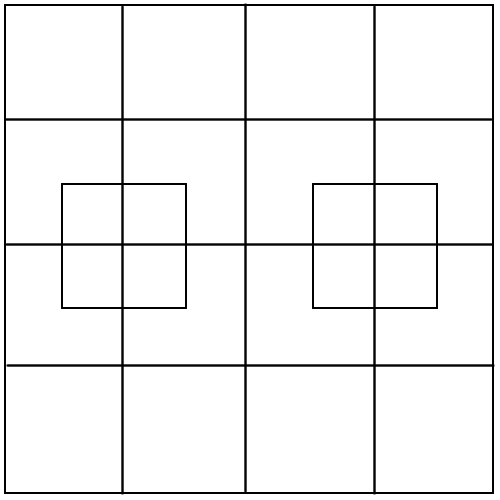
If the learners haven't had many opportunities for problem solving, reasoning, and working cooperatively in groups, the square puzzle is a good puzzle to start with for students in or above fourth grade.
While younger students will attempt to solve the puzzle with guess and check non systematic strategies they may discover (or the teacher may facilitate the idea) to systematically count the squares according to size and to construct an illustrations to show where each is.
Yet, if someone hasn't solved similar problems and operationalized this kind of procedure, it is challenging.
Decide on group size. Will they work alone, in pairs, triads, or groups of four.
I wouldn't recommend group sizes larger than four. Distribute to each group a work sheet and review the directions. For older students yoiumay want to remove the hints.
The time limit is not for the purpose of saying that everyone should find all the squares within the time, but is just to provide a guide for when to begin to share. Be willing to be flexible as you see fit.
When students ask if they have found all the squares, I would reply.
"You (plural meaning the group) are within criteria."
Criteria might be within two or 38-42 of the number of squares in the puzzle.
Or, "You (the group) are not within criteria."
I really try to down play the right answer and just say that in 15 minutes we will start to share and look at the different patterns of squares ... that we have collectively found.
I try never to say how many squares there are.
When students ask, I turn the question back to them by asking.
"How many do you think there are?"
If they say they aren't sure, then I ask them if they have found any pattern and if so how that might help them to have confidence in the number of solutions they have found.
For example: How many 1x1 squares? Use wait time.
Do you think there are more? and repeat that line of questioning and reasoning for 2x2, 3x3, 4x4, 1/4x1/4.
Then ask if there are 5x5? Why not? and If there are any other sizes?
Why? Why not?
Finally, try to summarize with, then I don't have to tell you if you are "right" you seem pretty confident that you are.
The only other hurdle is for students to discover that some squares overlap other squares. Usually this is discovered and passed around the class fairly quickly. However, with younger learners it might be a hurdle that they might need help to cross. Help by outlining a representation of each size.
Enjoy!
Integration of other math dimensions
Representation - Each of the five different size of squares can be outlined to represent each square size, then each sized square can be counted to find the total number. As this is done, each size could be color coded, could be ordered from small to large to account for each one. Or each square could be draw with each square on a separate sheet of paper and number each sheet for each square.
Actual story
One year I had this puzzle sheet in a learning center for students to do when they finished their other work.
When Teddy finished and asked if he was right, I asked him to point and trace with his finger where the squares were. After several attempts, he got frustrated when he would loose count or get lost. After three or so tries he got frusgrated, went back to the learning center, counted out 40 sheets of the puzzle papers, went back to his seat, and took several minutes to finish. Then they went to the stapler, emphatically stapled them together, came up to me, and said there. That proves it!
Yes!
Reasoning and proof - I can find all examples of each sized square, count the total number for each shape, add the different sizes and find the total. The proof is based on the fact that only a finite number of squares exists in the diagram and they can be counted. This conclusion is based on the definition of a square, the limited number of lines, and how and where they intersect in the diagram.
Problem solving - strategy guess and check, systematically organize, break down into small problems, solve each and put together.
Communication - I can communicate logically and systematically by arranging and representing the possible sizes of squares and illustrating where each is to communicate and convince others that our totals match.
Connections - All five process are used in solving this problem as well as geometry, spacial reasoning, number value, and algebra patterns.
Introduction or review of cooperative learning in groups
Also opportunities to teach skills in ...