Timeline of Significant Historical Political Events in Human Development
- Present era - modern (1500-present)
- Middle age
(1499 - 500) - City state & Agriculture
(499 - 10 000 BCE) - Hunter gatherer
prior 10 000 BCE
Modern 1700 - Present
Summary of change
Present
2005
Economics of growth
Paul M. Romer includes variables for economic growth as including: development of ideas, investment in research, education, resources, protection of patents, copyrights, and licenses; foreign investment, property rights, amount of regulation, tax rates, and investment in capital on the effects on economic growth.
- Source Economic Growth
- Economic Growth, October 12, 2015 article
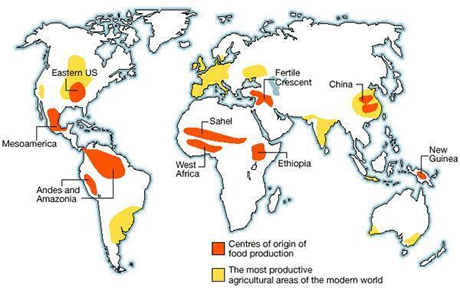
Farmlands have evolved to include: California, North America's Great Plains, Europe, Pampas in Argentina, Cape of Southern Africa, Indian subcontinent, Java and Australia's wheat belt. If these areas are so well suited for farming or herding, why weren't they used in the past?
Source Twitter.com
1980
Micro Computers
Paul M. Romer includes variables of research of ideas, investment in research, education, resources, protection of patents, copyrights, and licenses; foreign investment, property rights, amount of regulation, tax rates, and investment in capital on the effects on economic growth.
- Source Economic Growth
- Economic Growth, October 12, 2015 article
1977 - present ...
Voyger 1
Is launched 9-5, 1977; takes blue dot phot 2, 1990; becomes most distant human made object 2-17, 1998; crosses the termination shock; Passes reach of the solar wind 2-13, 2010; reaches interstellar space 8-25, 2012.

Photo of Earth taken by VOyager 1 between Uranus and Neptune. Original: NASA JP
1969 - 1971
SWAT
Special weapons and tactics concept originated as a result of several sniping incidents in Los Angeles during and after the Watts Riot. John Nelson presented the idea to Darryl F. Gates who approved 15 four-man teams on an as needed basis.
On December 9th, 1969 search warrants for illegal weapons were served at the Black Panther Party Headquarters. The members present resisted resulting in a shoot out with the 40 member SWAT Team. In the four-hour siege, thousands of rounds of ammunition were fired, wounding three Panther Party members and three SWAT members before Panther members surrendered.
In 1971, SWAT was assigned on a full-time basis to respond to subversive groups.
Before 1967 it was legal to carry fire arms in public in California. However, as governor, Ronald Reagan, signed the Mulford Act into law in 1967, which prohibited the general carrying of firearms in public. It was the most sweeping gun law in the country. Later as president he issued an executive order to ban the importation of some types of shotguns, and later supported the Brady Bill, and a Ban on Assault Weapons in 1994.
1968
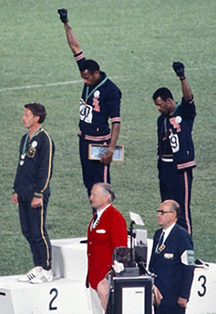
World Olympics 200 m award ceremony in Mexico City, Mexico.
From left to right. Australian Peter Norman and Americans Tommie Smith and John Carlos protest against racial discrimination in the United States of America. They were barefoot and listened to their national anthem with their heads bowed and black gloved fists raised.
Photo by Angelo Cozzi (Mondadori Publishers) [Public domain], via Wikimedia Commons

1961
Berlin wall is built, Bay of Pigs, Cairo, Egypt riots
1957
Sputnik launched by Russia
1954 -1980
Eyes on the Prize are documentary videos that recounts the fight to end decades of discrimination and segregation. It is the story of the people -- young and old, male and female, northern and southern -- who, compelled by a meeting of conscience and circumstance, worked to eradicate a world where whites and blacks could not go to the same school, ride the same bus, vote in the same election or participate equally in society. A world where peaceful demonstrators were met with resistance and brutality ... Source
Programs in the series:
- Awakenings (1954-1956)
- Fighting Back (1957-1962)
- Ain't Scared of Your Jails (1960-1961)
- No Easy Walk (1961-1963)
- Mississippi: Is This America? (1963-1964)
- Bridge to Freedom (1965)
- The Time Has Come (1964-66)
- Two Societies (1965-68)
- Power! (1966-68)
- The Promised Land (1967-68)
- Ain't Gonna Shuffle No More (1964-72)
- A Nation of Law? (1968-71)
- The Keys to the Kingdom (1974-80)
- Back to the Movement (1979-mid 80s)
1954
Brown vs. Board of Education Topeka. The equal protection ruling in Brown was later applied to laws and rulings for the right of equal access to public and political areas for all.
1947
Jackie Robinson and integration of baseball
April 15, 1947, Jackie Robinson stepped onto Ebbets Field in Brooklyn as the first African American player in Major League Baseball. The color barrier was broken and the face of sports began to change.
Jackie Robinson, There is always going to be a price to pay for any rebel sound that challenges oppression. If you showed anything that suggested dignity and necessarily you believed in equality you were immediately undesirable. Be a good nigger.
Rachel Robinson, He couldn't continue to be silent and to be subordinant. He had to be himself and he had to represent the race as well as himself.
Jackie Robinson, As long as I appeared to ignore insult and injury, I was a martered hero, but the minute I began to argue, the minute I began to sound off. I became a swell head, a wise guy, an uppity nigger. When the white player did it he had spirit. When the black player did it, he was ungrateful. I was a fine guy until I began to change. Jackie Robinson,
1930's
Depression
The Great Depression created many families who didn't have the means to provide for their own needs and became dependent on state and federal government for assistance. Education relied on property taxes, which decreased as businesses failed and land values fell. Chicago in 1934 borrowed $22 million so it could pay teacher salaries owed for three years of work.
1929+
African American representation in Congress 1900 +
Oscar Stanton De Priest, was the first African American elected to Congress in the 20th century and served from 1929-1935. His election challenged the status quo of segregation in the nation’s capital, Washington D. C. He and his wife, Mrs. Jessie De Priest, struggled to be accepted and worked to get rid of segregation. Source
1945-1971, Adam Clayton Powell Jr. was elected from Harlem, New York City, and served in the United States House of Representatives from 1945 - 1971 (fourth African American elected after 1900). Prior to serving in the House he was elected to the New York City Council, in 1941, the first black council member. Source
Blacks were essentially excluded from politics until after civil rights legislation passed in the mid-1960s.
See also 1870+ African American representation in Congress after the Civil War
1927
Mississippi Flood created big government
Calvin Coolidge was president during the 1927 Mississippi Flood where more than 23,000 square miles (60,000 square km) of land was submerged, hundreds of thousands of people were displaced, and around 250 people died. Source
Coolidge believed service and public works were best provided by local and states government to the extent that he said ...
"If the federal government were to go out of existence, the common run of people would not detect the difference."
The legislative result of the flood was The Flood Control Act of 1928. Source
1924
The Indian Citizenship Act of 1924, The Snyder Act
The U.S. Congress passed the The Indian Citizenship Act, which provided citizenship for all Indians.
In 1927, the White House was occupied by a president who, like George W. Bush, had little use for activist government (at least at home): Calvin Coolidge. "If the federal government were to go out of existence," he said, "the common run of people would not detect the difference." Those services people needed, he thought, the states could best provide. Coolidge forged his views in the rural Vermont of his youth—a landscape of homogenous Yankee communities that celebrated thrift, piety, and self-reliance. And while Coolidge's old-fashioned rectitude made him beloved in the wake of Warren Harding's Teapot Dome scandals, the president's philosophy was becoming increasingly ill-suited for 20th-century realities.
1923
Equal Rights Amendment -
Alice Paul, and other suffragists, argued the nineteenth amendments alone would not end discrimination based upon sex. Paul drafted the Equal Rights Amendment and, in 1923, presented it as the "Lucretia Mott Amendment" at the 75th anniversary of the Seneca Falls Convention and the Declaration of Sentiments.
Later that same year it was introduced in the Congress. It has always been controversial regarding the meaning of equality for women. Spokesmen for the working class were strongly opposed, arguing employed women needed special protections regarding working conditions and hours. In 1972, it passed both houses of Congress and was submitted to the state legislatures for ratification. It seemed headed for quick approval until Phyllis Scholarly mobilized women in opposition, arguing it would disadvantage housewives. Congress had set a ratification deadline of March 22, 1979. By 1977, the amendment had 35 of the necessary 38 states needed for ratification. Five states later rescinded their ratifications before the 1979 deadline. In 1978, a joint resolution of Congress extended the ratification deadline to June 30, 1982, but no further states ratified the amendment and it died.
1920
Nineteenth Amendment
Granted women throughout the United States the unabridged right to vote.
1879
Standing Bear v. George Crook, Native Americans were ruled persons
Presiding Judge Elmer Dundy of the US District Court in Omaha, NE,
Standing Bear and other Ponca Indians were living; on their reservation in Niobrara, NE. Farming and sending their children to school before they were removed and taken south to where crops would not grow and 158 people died before a small group decided to return to their Niobrara reservation. They left and headed north until they were captured on the Omaha reservation and brought to Omaha where a writ of habeas corpus was filed.
The case was became centered on: do Indians have a legal right to a writ of habeas corpus (a court order, that literally meaning to produce the body, or a court order to bring a person into the court room to decide if the person has been detained, jailed, or imprisoned legally). Standing Bear's attorneys argued the government had no justification to arrest and detain them. They claimed the law was clear. It said nothing about being a citizen. It said only that: any person or party had a legal right to apply for a writ.
The government's attorney argued the court overstepped its legal boundaries and had no legal right to compel the government to justify its arrest and relocation of the Indians south, because an Indian has no legal right to sue in federal court. Further no writ has ever been issued for an Indian and can not be.
Dundy ruled: It was illogical to assume since no Indian ever sought a writ of habeas corpus, that Standing Bear could not seek one. The court had jurisdiction, because Standing Bear and the Ponca had been restrained of their liberty in violation of a treaty provision and only the federal court can determine if the prisoners’ constitutional rights were violated.
He wrote: "It would be a sad commentary on the justice and impartiality of our laws, to hold that Indians, though natives of our own country, cannot test the validity of an alleged illegal imprisonment.”
As to who could legally apply for a writ. The government steadfastly argued only citizens could. And since Indians were not citizens, they could not sue. However, Dundy ruled person not citizen was the required criteria and wrote: a reasonable definition of a person can be found by consulting a dictionary. “Webster describes a person as ‘a living soul; a self conscious being; a moral agent; especially a living human being; a man, woman or child; an individual of the human race.’” This, he said, “is comprehensive enough, it would seem, to include even an Indian."
The judge noted, Standing Bear and the Ponca had done all they could to terminate their tribal allegiance (expatriate) and become independent farmers, provide education for their children, and adopt the ways of civilization.
Dundy noted that on July 27, 1868, Congress declared the right of expatriation (to withdraw oneself from residence of one's native country) was a natural and inherent right of all people, indisputable to the enjoyment of the rights of life, liberty , and the pursuit of happiness.
Leading Dundy to the decision: An Indian “possesses the clear and God-given right to withdraw from his tribe and forever live away from it, as though it had no further existence.”
Finally, did the government have a legal right to remove Standing Bear and the Ponca from the Omaha Reservation and send them back to the southern Indian Territory?
Dundy wrote, no such power exists. The government can not arbitrarily round up Indians who had severed their tribal ties and simply move them whenever and wherever it wanted. Unless, they were deemed detrimental to the peace and welfare of the reservation. But in such cases, the law required they must be turned over to civilian – not military – authorities.
In summary, Judge Dundy concluded,
- An Indian is a PERSON within the meaning of the laws of the United States, and has therefore the right to sue out a writ of habeas corpus in a federal court.
- General Crook illegally detained the Ponca prisoners.
- The military has no legal authority to force removal of the Ponca to Indian Territory.
- Indians possess the inherent right of expatriation as well as the more fortunate white race, and have the inalienable right to ‘life, liber ty and the pursuit of happiness....’”
- And, since they have been illegally detained in violation of their constitutional rights, the Ponca “must be discharged from custody.
Judge Dundy had done something unprecedented: He granted the hearing and declared, for the first time in the nation’s history, an Indian was a person within the meaning of U.S. law with legal rights whites were required to uphold. Unfortunately, Judge Dundy did not address the issue of citizenship for Indians. It would not be until 1924 when Congress passed the Citizenship Act, which provided citizenship for all Indians. Source
1870+
African American representation in Congress after the Civil War
After the Civil War and during reconstruction: laws, new constitutions, and other procedures were deliberately used to prevent black citizens from registering and voting. These defied the Fifteenth Amendment to the United States Constitution, ratified in 1870, which were intended to protect the voting rights of free men.
Henry P. Cheatham, was one of five African-American politicians elected to Congress from the South in the 1800's.
See also 1929+ African American representation in Congress after 1900.
1875 First official college football game was played in New Jersey: Rutgers vs Princeton
1870 Christmas was declared a federal holiday
1863 November 19
 Lincoln's Gettysburg Address
In Lincoln's words, the power of the address is about what the civil war preserved...
"One nation over state's rights to go their own way. A unity of national majority rule. "... that this nation shall have a new birth of freedom; and that this government of the people, by the people, for the people, shall not perish from the earth."
Hay version.
1862
War, the fallen ...
Battle of Antietam was the first time a photograph of American dead was published.
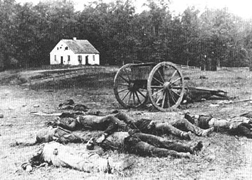
In kingdoms the bodies of the people belonged to the king and could be used as the king saw fit so notification of family and what to do with the remains was at the kings discreation. In small war parties warriors knew each other and if the were lucky enough to return, they could report to families and sometimes return bodies if there was an opportunity to do so.
As armies got larger, fighting lasted longer, and soldiers were moved after a battle, those who fell on the battle field were left behind. Fellow soldiers often felt obligated to send letters or report to their comrads families the circumstances of their deaths.
It wasn't till after the war that people asked congress to pass and fund a low to collect and inter the bones of the fallen. Thus, began the idea that notification of family, burial, or return of the body was the responsibility of the government.
The bill that was written didn't address the collection of bones for all Civil War soldiers. The confederate soldiers were not included and black soldiers were discriminated as to their final resting place in some cemeteries. Ladies of Hollywood Memorial Association is one such group formed in the south to collect, move, bury, and care for the graves in Richmond’s Hollywood Cemetery. It is also thought this group began the idea of Memorial Day to honor the fallen.
Photo by Mathew Brady
1869
Transcontinental railroad was opened for through traffic on May 10, 1869 with a ceremonial driving of the last spike. The spike, referred to as the golden spike, was driven with a silver hammer, at Promontory Summit, Utah.
1776
An Inquiry into the Nature and Causes of the Wealth of Nations by Adam Smith.
wealth is regulated by:
- The quality, skill, judgement of the workers, specialization
- The productive workers,
- The proportion useful workers and non useful workers or unemployed.
- Product distribution, supply and demand, trade, barriers, price control, tariffs
- Investments, capital stock and its use.
- How capital and stock are accumulated and distributed in ways that are good, kind, and show concern.
- National labor practices
- How labor focuses on supply and consumption.
- Revenue of governments, taxation, monopolies, cartels
1762
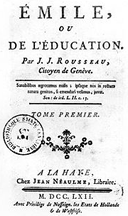 Jean-Jacques Rousseau - (1712 -1778)
French author who wrote:
Emile or a Treatise on Education.
The book is considered the first educational philosophy book as well as the first child psychology book.
Rousseau claims children have a natural goodness and can become critical life long learners and educated citizens if they can survive a corrupted society.
Rousseau is sometimes referred to as the father of modern child psychology.
1686
Isaac Newton published Principia Mathematica 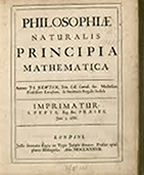
Adapted from Isaac Newton [Public domain], via Wikimedia Commons
%2C_title%2C_p._5%2C_color.jpg)
1561 – 1626
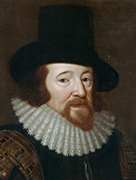
Sir Francis Bacon -
Sir Francis Bacon rejected that syllogism (Aristotle 360 BCE) was the best way to draw conclusions about the natural world. He suggested an inductive approach of skeptical observation and experimentation with facts and explanation leading to conclusion. Because of this he has been called the father of empiricism and the father of the scientific method.
"British - Francis Bacon - Google Art Project" by British (School, Details of artist on Google Art Project) - UwEFEzZpMHs4JA at Google Cultural Institute, zoom level maximum. Licensed under Public Domain via Commons.

1582
The Gregorian calendar / Western calendar / Christian calendar, is named for Pope Gregory XIII, who introduced it in October 1582.
Middle age - 1499 - 700
Summary of change
1225
Huns and Ghengis Khan movements...
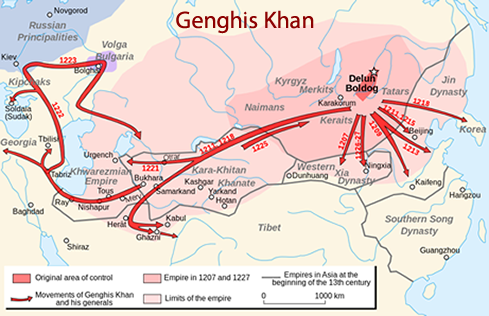
Adapted from Bkkbrad (talk) Gengis_Khan_empire-fr.svg: historicair 17:01, 8 October 2007 (UTC)
(Gengis_Khan_empire-fr.svg) [CC BY-SA 2.5-2.0-1.0, GFDL or CC-BY-SA-3.0], via Wikimedia Commons

City state and Agriculture: 699 - 10 000 BCE
Summary of change
300 - 400
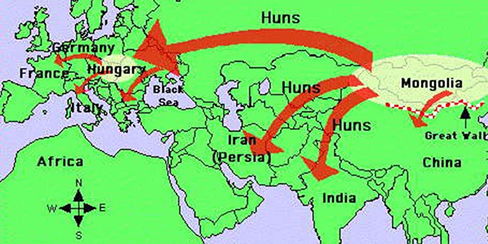
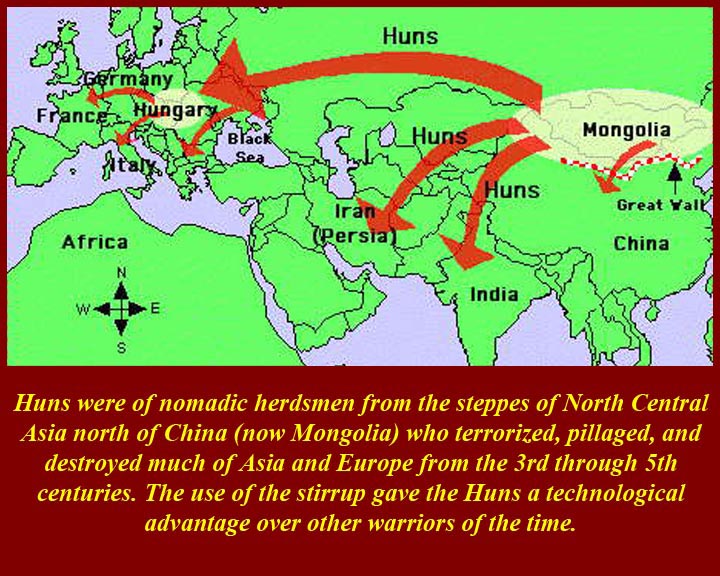
Nomadic tribes of Northern Asia invaded China, eastern Asia, and Europe. With superior horse skills and the stirrup destroyed villages, the current political structures, and changed peoples lives.
360 BCE
Aristotle - 380 - 322 BCE
Continued with teaching of rhetoric and added syllogism, use of logic.
- Argued that education should be controlled by the State.
- People learn to be virtuous with practice.
- Ethics, become just by performing just acts. Learning becomes doing or acting.
- If what is being done is virtuous, then learning was intrinsically valuable for the individual and society-the State.
407 BCE
Plato and Socrates
427 - 347 BCE developed a philosophy of education - learning happens when the teacher asks key questions. Socratic Method. The Republic. Education based on interests, abilities, and stations in life. Utopian ideal to produce philosopher kings or guardians rule to the State. Built on Greek rhetoric: the art and process of effective public speaking. First taught by the sophists. See 480 BCE sophist.
Dialectic reasoning or dialectics (Socratic method, Hindu, Buddhist, Medieval, Hegelian dialectics, Marxist, Talmudic, and Neo-orthodoxy.), and modern debate. All involve conversations between two or more people arguing different points of view for the purpose of establishing truth with reasoned argument.
Socrates valued truth as the highest value. Truth discovered through conversation with reason and logic (dialectic reasoning). Logic, not emotion, to discover truth for persuasion and make choices to guide one's life. To Socrates, truth, not art, was the greater good to guide one's life. Therefore, Socrates opposed the sophists and their teaching of rhetoric as art and as emotional oratory requiring neither logic nor proof.
Dialectic method, rhetoric, and debate can have fundamental differences. In theory debate may be considered as unemotional and committed to rational argument. However, in practice debaters can present emotionally charged ideas to suppress rational thought, hoping to persuade others to their point of view. See rhetoric in 480 BCE sophists
480 BCE
Sophists - 480 - 390 BCE
The first teachers of rhetoric: : the art (arte) and process of effective public speaking, in the Greek world were known as the Sophists, or wise men. They taught by example skills of civic life and explored a wide range of human experience within Greek culture. Not being of Athens they often clashed culturally and philosophically with the Athenians.
They taught art had the highest value in life and it should be used to make choices and to seek it out in all things. To them the artistic quality of a speech or oration was its power to motivate, influence, and please people. Therefore, oration was taught as an art form, which was used to please, motivate, and influence other people through quality speaking. Maybe the historical basis for Declamations which are students interpretations of famous speeches they regive to demonstrate their ability to understand and apply the purpose and power of the speech and skill in public speaking. Samples
Rhetoric is a method or art of speaking or discourse/ conversation to persuade, inform, or motivate an audience. Concepts of rational appeal (logos), emotional appeal, (pathos), and ethical appeal (ethos) are all intentionally used to persuade and convince people of a particular idea or argument.
1
Hunter gatherer: prior 10 000 BCE
Summary of change
9 000 years ago
Kennewick man skeleton found in Washington shares DNA that suggests it is an ancestory of the Native American tribes of the Coville Reservation.
10 000 years ago ...
One might think that many hunter–gatherer societies stumbled upon domestication and took up farming. However, this seemed to happen in only nine places around the world: Fertile Crescent, China, Mesoamerica, Andes/Amazonia, eastern United States, Sahel, tropical West Africa, Ethiopia and New Guinea.
History from now until today includes many tales of hunter–gatherer societies being driven out, infected, conquered, and exterminated by farming societies where farming is possible. Except the Huns and Atilla see 300-400 & 1225.
Hunter–gatherers of the Fertile Crescent domesticated wheats, barley, peas, sheep, goats, cows and pigs to become the first farmers and herders, beginning around 8500 BC. This led to major changes: shorter birth intervals (from four years to one year) political changes (social classes, kings, soldiers, empires, professional armies), and technology (metal tools, writing, ...). These were tools of conquest and allowed them to spread into Europe, North Africa, western India, and central Asia. However, having no other advantages power shifted to Greece then Italy and then to northwest Europe. While human societies in the Fertile Crescent inadvertently committed slow ecological suicide as low rainfall caused deforestation, soil erosion and salinization.
Source Nature, Jared Diamond
13 000 years ago and maybe earlier ...
Humans began to farm rather than maintain a hunting and gathering existance. The belief that farming was a step up is probable inaccurate as farming required more work, lower adult status and resulted in worse nutritional conditions, poorer sanitation, and more disease. What ever the circumstances the result was changes in plants, animals, and human behaviour that interacted with each other and lead to humans building of cities . Source Evolution, consequences and future of plant and animal domestication, by Jared Diamond.
It may also be possible that the food supply of wild animals was shrinking to a point of unsustainability as 100's of large mammals had been hunted to extinction by humans. Source Sapien
Cooking, grinding, leeching, soaking
Wheat, barley, seeds with non shattering seed pod or head
Goats, sheep, cattle, chicken, pigs, For the species which were not domesticated. Is the reason that it was difficulty to domesticate each of those species?, or Were the indigenous people that lived where the species was native not inclined to domesticate them?
23 000 years ago
Ohalo II located on the shore of Galilee was clearing land, sowing wheat and barley and harvesting them 23 000 years ago. Ehud Weiss and his team have collected
150 000 specimens of plant remains from the site.
2.2 million years ago
South Africa Sterkfontein Cave a hominin Australopithecus afarensis or A. prometheus? Little Foot. Source & image
2.6 million years ago
Stone tools found at Gona in Ethiopia, were dated to 2.6 million years ago. They match tools known as the Oldowan, named after Olduvai Gorge in Tanzania, where Louis Leakey found similar tools in the 1930s. These tools were so well knapped that they were believed to have evolved from a less technological tool-making culture.
2.8 million years ago
Fossilized jaw found at Ledi-Geraru, Ethiopia was dated as 2.8 million years old and classified as Homo genus.
3.3 million years ago
Stone tools at the Lomekwi site near Kenya's Lake Turkana were found by Sonia Harmand and her team, which were dated to 3.3 million years old . Source
3.3 - 3.5 million years ago
A hominin jawbones was dated and classified as Australopithecus deyiremeda. They were found in the Afar region in Ethiopia. Source & image
50 million years ago
Australia broke away from Antarctica and trapped Mungo Man in Australia.