Make a dolphin
Life goes on forever like the gnawing of a mouse.

Directions
The purpose of this activity is to create a 40 pound dolphin using a food chain with the following organisms:
- Diatoms
- Copepods
- Oysters
- Crabs
- Fish
- Dolphin
Make the following assumptions:
- A dolphin feeds only on fish.
- Only 10% of what any organism eats is used to grow to adulthood.
- All organisms being eaten are adults.
- The average weight of an adult dolphin is 40 pounds.
- There are five feeding levels in the chain that feeds your dolphin.
- - diatoms,
- - copepods,
- - oysters,
- - crabs, &
- - fish
- The organism, from the bottom level to the upper level, is the food for the organism above it on the food chain.
- Add arrows, on the ocean energy web, to show how food energy is passed from organism to organism.
How many pounds of each organism is needed to make a 40 lb adult dolphin?
How many pounds of diatoms?
How many pounds of copepods?
How many pounds of oysters?
How many pounds of crabs?
How many pounds of fish?
Ocean energy web

Hint 1:
Work backwards from the dolphin:
Hint 2:
Working backwards. Think about how much fish a dolphin needs.
Since only 10 percent of the material at each level is used to build the organism at the next higher level, it will take 400 pounds of fish to make one 40 pound adult dolphin.
Hint 3:
4 000 000 pounds of ________________;
400 000 pounds of ________________;
40 000 pounds of ________________;
4 000 pounds of ________________ and
400 pounds of ________________
to make one 40 pound ________________ .
Brian buster:
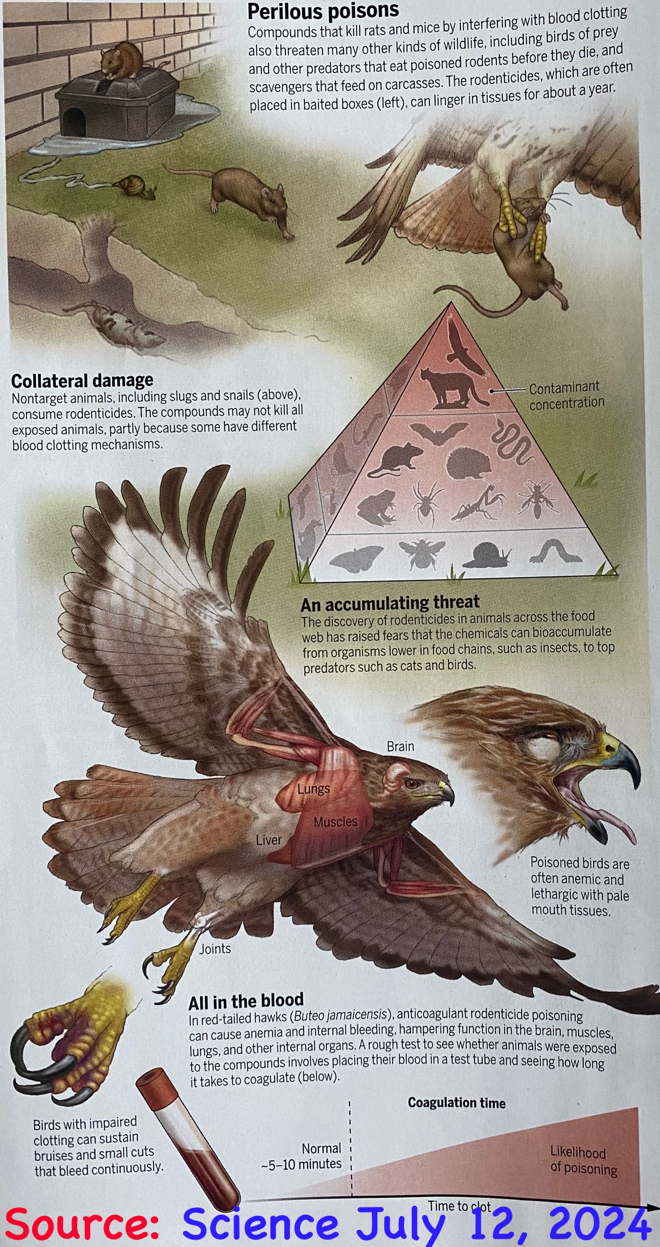
Using what you learned about food chains and the growth of a dolphin, describe how poisoning rats can affect other animals in the environment. Share your explanation in class, at a dinner table, in your journal, or in a video clip.
Extension actitivies with resources
Activity 1
Use the ecosystem model diagram to complete the following:
- Put the organisms on the ecosystem model as a producer, consumer or decomposer.
- What additional organisms might be added?
- Describe how they are connected in a food web.
Activty 2
Fruit and vegetable decomposition timelapse vide YouTube (1:36)
Activity 3
Use the ecosystem model diagram to complete the following:
- Put organisms from your backyard or neighborhood on the ecosystem model as a producer, consumer or decomposer.
- What additional organisms might be added?
- Describe how they are connected in a food web.
Activity 4
Food webs in other ecosystems!
Activity 5
How Wolves Change Rivers - YouTube video (4:33) - Trophic cascade - how a predator at the top of the food chain (web) can make changes at the bottom! Wolf reintroduction in Yellowstone Park in 1995 affected deer, birds, willow, aspen, beaver, coyotes, rabbits, mice, bears, berries, ... rivers, and the physical geography of the land. Stream and meandering unit!
Another example of interconnectedness of species within ecosystems.
Gross et al. found that when wolves ate blueberries, they scattered the seeds in their scat, which increased blueberry seed germination between 5-27%.
Source
Wolves increase germination speed and success of blueberries. Biology Letters, Volume 22, Issue 20260279.