
Static Electricity
Unit with activities
Questioning is the foundation of all learning.
The first step in rejecting not knowing is to ask, why?
Sweetland

Introduction
- Introduction
- Big ideas, concepts, facts, & outcomes
- Science content concepts & outcomes
- Inquiry & science process concepts
- Anticipated learnings & misconceptions
- Pedagogical overview
- Activities sequence
- Focus questions
- Materials
- Scoring guide suggestions
- Unit activity sequence
- Activity 1 - Toe Dancing Tinsel
- Activity 2 - The Great Electron Rip-off
- Activity 3 - The Mysterious Moving Ping-Pong Ball
- Activity 4 - Make a Balloon Ec-Static Today!
- Activity 5 - Pepper and Salt
- Activity 6 - Make the Paper Dance
- Activity 7 - Fill the Stocking & make a lightening storm in your bed.
- Lab notes
- Lab note 1 - Toe Dancing Tinsel
- Lab note 2 - The Great Electron Rip-off
- Lab note 3 - The Mysterious Moving Ping-Pong Ball
- Lab note 4 - Make a Balloon Ec-Static Today!
- Lab note 5 - Pepper and Salt
- Lab note 6 - Make the Paper Dance
- Lab note 7 - Fill the Stocking
- Support materials
A unit comprising a sequence of activities designed as an introductory study or a review to deepen one's understanding of static electricity. The unit can serve as a complementary study to electricity, magnetism, and energy.
Background resources:
This plan is designed for learners who have very little prior knowledge of electricity and static electricity. However, the unit encompasses sufficient activities and information to provide comprehensive content for more learners.
Related study topics:
- Current electric unit with activities plans & lab pages
Historical learning cycle plan - Force, mass, & movement
- Magnetism Unit
- Motion unit: Spinners: tops, zoomers, twirlers, rollers: wheels, wheels & axles, cups, & spheres ( Primary grades and above)
Planning information
Learner background information
A plan designed for learners who have prior knowledge in cause and effect, use of observations to make inferences, models as explanations for observable and non observable events, and working in groups.
Intended learnings & learners thinkings
See for more information on what to include in general planning
Content concepts or outcomes
(Source concepts & misconceptions)
Big ideas and specific outcomes:
Some kinds of static electricity are easy to understand.
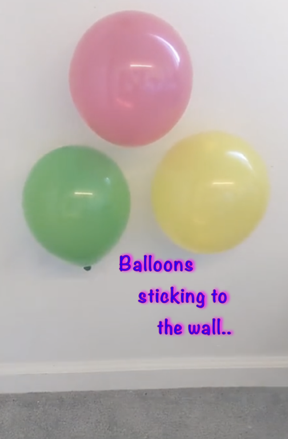
Rub a balloon against your hair, and negative charges will accumulate on the rubber because it has a greater affinity for holding charges. Your hair, now positively charged, will be attracted to the balloon. And because like charges repel, strands of your hair will splay out from each other.
However, identical materials with identical affinities can also exchange charges, seemingly without rhyme or reason. For example particles in volcanic ash plumes somehow build up enough charge to trigger lightning; dust in grain silos can spark and explode, and smoke from forest fires can create their own lightening.
In a study published this week in Nature, researchers say they have finally found why: trace amounts of surface contamination by carbon-bearing molecules from the air. This revelation resolves "one of the bigger questions in the field, a scientific mystery that has lasted for decades.
Concepts and facts
Outcome
Use and describe
Science concepts: physical, earth, life
Big ideas:
When an object gains electrons it has a surplus of electrons and so it has a negative charge. When an object loses electrons, it has a shortage of electrons so it has a positive charge. The reaction of the positive and negative charges between objects causes static electricity.
Note:
When working with static electricity, weather conditions can have a major effect on experiments with charges.
The activities work best on cold winter days when there is low humidity.
Higher humidity means there are more water droplets in the air. This means that when a charge is built up on any object (comb or balloon), the charges will attracted to the water in the air and they will be repelled away, reducing the charge you are tying to build. With higher humidity more water molecules will take more of the charge from the object until it will lose the charge and return to neutral.
Related concepts
- Static electricity is the reaction of tiny particles called electrons.
Outcome
- Explain static results from a difference in charges on different objects. Differences can cause a force of attraction or repulsion. Big enough differences can cause a sudden discharge that is like miniature lightening.
Anticipated learner thinkings & misconceptions
- The balloons stick because it is magic.
- The balloons are sticky.
Inquiry, process, & cross cutting concepts & skills
Inquiry
- When I experiment I collect observations that describe how different properties change (become variables) when objects and systems interact. This helps me make claims, explain what is happening, and to predict what might happen in the future.
- Inquiry concepts
- Process concepts
- Perspective concepts
cross cutting
Big ideas: See also Concepts & misconceptions
Observations can be used to recreate interactions by employing explanations or models grounded in evidence.
Related concepts and facts
- Observational data and reasoning is used to explain interactions. Evidence is something that
is observed and can be used to understand what is happening and make predictions
about future changes.
- Models are structures that correspond to real objects, events, or classes of events. They can be mental constructs to explain interactions, or drawings that explain interactions.
- Explanations are based on observation derived from experience or experimentation and are understandable.
- Pictures or symbols represent objects.
Outcome -
- Create interactions with objects and static charges that demonstrate static as energy (force that can create motion).
Specific outcomes -
Other possible concepts
History of science and development of technology - perspective of science
See also Concepts & misconceptions also science, math, technology timeline
- People have practiced science and technology for a long time.
- Science develops over time.
- Science investigators such as
Scoring guides suggestions (rubric)
(scoring guide)
Top level
- Describes static as electrical forces with two different charges that can balance, attract, or repel.
Lower level
(scoring guide)
Top level
- Uses a model to explain and predict observations and interactions between real objects with unobservable forces that are supported as existing (electricity, static).
- Uses a model to explain and predict observations and interactions between real objects with unobservable forces (magic, electricity, static).
- Uses an interaction as an explanation or model. The balloon stuck to the ceiling.
- Uses an observation as an explanation or model. The balloon is on the ceiling.
Lower level
Strategies to achieve educational learnings
Based on learning cycle theory & method
Instructional Procedure
Pedagogical Overview
Activities Sequence to provide sufficient opportunities for learners to achieve the targeted outcomes.
Make sure learners have the prior knowledge identified in the background information.
- Activity 1 - Toe Dancing Tinsel
- Activity 2 - The Great Electron Rip-off
- Activity 3 - The Mysterious Moving Ping-Pong Ball
- Activity 4 - Make a Balloon Ec-Static Today!
- Activity 5 - Pepper and Salt
- Activity 6 - Make the Paper Dance
- Activity 7 - Fill the Stocking & make a lightening storm in your bed.
Focus question
Unit focus question:
What is static electricity? How does it work?
Sub focus questions:
- What is static electricity?
- How does it work?
Materials
- Strands of holiday tinsel, 1 pressed foam meat tray (clean and dry), clear transparent tape, wool, rubber comb, ping pong ball, round balloons, string, acrylic sock or cloth, salt & pepper, pain of glass, foil, silk or nylon cloth, stretch plastic bag
- Lab note 1 - Toe Dancing Tinsel
- Lab note 2 - The Great Electron Rip-off
- Lab note 3 - The Mysterious Moving Ping-Pong Ball
- Lab note 4 - Make a Balloon Ec-Static Today!
- Lab note 5 - Pepper and Salt
- Lab note 6 - Make the Paper Dance
- Lab note 7 - Fill the Stocking
Resources
Lesson Plans
Activity 1 - Toe Dancing Tinsel
Materials
- Strands of holiday tinsel, 1 pressed foam meat tray (clean and dry), 1 piece of notebook or typing paper, and blunt end scissors
- Lab note
Focus questions:
- What is a force?
- Do you think a force comes from a piece of tinsel?
- A meat tray?
Learning outcomes:
- Explain that there is a force between the tinsel strands.
Suggested procedures overview:
- Put learners in groups, focus their attention, and assess their initial understanding of the focus questions.
- Activity - Manipulate the tinsel and meat tray so the tinsel will repel and explain that there is a force between the tinsel strands.
Exploration -
- Organize learners into pair groups.
- Ask. Ask if they can think of a way to move the tinsel without moving their hand.
- Hold ends of the tinsel together in one hand. Trim the bottom of the tinsel so that the strands are all the same lengths.
- Rub the meat tray back and forth with the piece of paper to charge the tray with static electricity.
- Slowly lower the strands of tinsel until their tips come close the center of the tray. Slowly move the tinsel up and down and side to side over the tray. (Do not let the tinsel actually touch the tray).
- Ask what do you observe?
- How can you explain what you see?
- Rub the tray again to recharge it. Predict what will happen if you hold the tray to the side or above the tinsel. Do it and see what happens. Move the tray around to see how the tinsel reacts.
- Learners should share with a partner if your predictions were close.
- Have them discuss why they think it happens.
- Ask. Do you think different lengths of tinsel would make a difference. Let them try it.
Invention -
- Review and ask how they might summarize what they observed. Accept all answers.
- Ask what is force - Is a push or pull that may cause motion.
- Ask. Is there a force? yes
- Where would you say the force is coming from? Accept all answers.
- Ask. Do you think there is a force coming from the tinsel or the meat tray? Accept both as possible.
- Ask. Do you think there is a force coming from the pencil sharpener, the ceiling ... yes
- Is the force of other objects in the room strong enough to cause the tinsel to move? probably not
- So, we can probably agree that ... There is force that pushes or pulls the tinsel. And it probably is coming from the tinsel or the meat tray. And some people would call it static.
- depending on the experiences of the learners you can leave it here and have them draw a model show forces ... OR you if you believe the learners are ready you can add the idea of static electricity has charges, positive and negative, and ... OR wait for later activities ...
Discovery
Ask them where at home they would be able to see the same kinds of results. Tinsel on Christmas tree, a bow on a present, their hair may do the same thing.
Activity 2 - The Great Electron Rip-off
Materials:
- 2 one-foot pieces of clear plastic tape
- Lab note
Focus questions:
- What other objects can static forces?
Learning outcomes:
- Describe the four different positions two pieces of tape can be placed against each other, describe how forces will either cause them to attract or repel, and explain with a model how the force might act.
Suggested procedures overview:
- Put students in groups, focus their attention, and assess their initial understanding of the focus questions.
- Activity - Use transparent tape and observe how they interact after they are charged. Then, Describe the four different positions two pieces of tape can be placed against each other, describe how forces will either cause them to attract or repel, and explain with a model how the force might act.
Exploration
- Organize learners into pair groups.
- Ask. What will happen when two pieces of tape are put together. If they are placed sticky sides together they stick, if the sticky sides are part the backs of the tape won't stick. If they are place facing the same direction one will stick to the other and ...
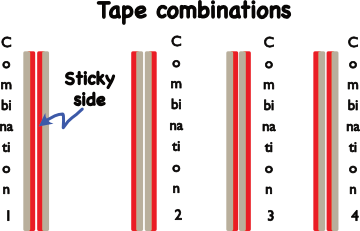
Demonstrate the following, with a strip of paper. So the learners can have the opportunity to see what happens when they complete the activity.
- Stick a length of each piece of tape to a smooth hard desk or counter top. Allow about enough of each length of each piece to hang over the end of the counter so that you can easily grab it and rip it off.
- In each hand, grab one end of the pieces of tape and quickly rip it off the counter.
- Allow the pieces of tape to dangle, but do not let them touch anything (or each other yet).
- Slowly bring the pieces of tape near each other.
- Notice what you observe?
- Discuss how you might explain why this happens? (The name of the activity should give you a clue).
Try another one!
- Stick one of the pieces of tape to your work surface again. Although tape is sticky, rub the entire length of the other strip by pulling it between your thumb and index finger.
- Now rip off the first piece of tape from the counter and let the two pieces hang near each other.
- Notice What happens? Do the pieces attract or repel? Do you think the pieces have like charges or opposite charges?
Let the students explore with the tape in different ways and be ready to report back to the class their results.
Invention
- Regroup and review their results.
- Ask. What did you find out about tape and their charges?
- Review the two activities on their lab notes.
- Ask. Did anyone try an additional investigation with the tape? Listen to all answers
- Did you consider what might happen if both pieces were pulled between your finger and thumb and then hung next to each other?
- If they didn't, Try it and see!
- Review the different ways the tape could have been placed together.
- Make a table.
Discover
Ask. where they could use what they learned.
Activity 3 - The Mysterious Moving Ping-Pong Ball
Materials:
- 1 unbreakable or rubber comb, 1 Ping-Pong ball, and 1 tape measure, wool cloth (optional)
- Lab notes
Focus questions:
- How can you move a ping-pong ball without touching it?
Learning outcomes:
- Move a suspended ping-pong ball with touching.
Suggested procedures overview:
- Put students in groups, focus their attention, and assess their initial understanding of the focus questions.
- Activity - Demonstrate moving a ping-pong ball with a static charge and explain how a charge is created on the comb that will interact with the ping-pong ball with enough force to move it.
Exploration
- Organize learners into pair groups.
- Ask. How can you move a ping-pong ball without touching it?
Demonstrate - without actually combing and moving the ball.
- Place the Ping-Pong ball on a smooth flat surface. Run a comb through your hair about 10-15 times. Now the comb should be charged with static electricity. (If your hair is too short you can rub the comb with a wool cloth).
- Bring the back of the comb near, but not touching the side of the Ping-Pong ball.
- Slowly move the comb away from the ball.
- What happens?
- Does the ball follow the comb?
- Do you think it would if you had not run the comb through your hair?
- See how far you can make the Ping-Pong ball travel this way.
- Measure the distance with your tape measure.
- Have a contest with your partner. Using separate combs, see who can make the Ping-Pong ball go the farthest.
- Why do you think one went farther than another?
- You can also have a race! Mark a finish line about 1 yard away from the starting line. Put both Ping-Pong balls on the starting line. Have another person say "GO!" When they say go, you and your partner should start combing your hair. Quickly use your comb to get the Ping-Pong ball to move. If your ball stops before the finish line, comb your hair again for some extra static electricity.
Invention
- Report back what happened.
- Ask. How many times they had to stop to comb their hair and ask why.
- When a plastic comb is run through hair, it gains excess electrons (which are negatively charged particles), making it negatively charged. When it is brought near a neutral ping-pong ball (or small pieces of paper), it induces a positive charge on the side closest to it.
- Before, next next, next models
Before
The comb is neutral, and the ping-pong ball is neutral. Meaning the electrons and protons are distributed evenly throughout both objects.
Next (Rubbing the comb or charging it):
Rubbing the comb on hair transfers electrons, to the comb giving it a negative charge (-).
Next (Interaction)
When the negatively charged comb approaches the ping-pong ball, it pushes, (repels) the electrons within the ball's surface. These electrons move to the far side of the ball so the side of the ball closest to the comb becomes positively charged (due to the presence of more protons), while the far side is negatively charged (due to the presence of more electrons). Because the positive side is closer to the negative comb than the negative side is more attracted.
Next
If the ping-pong ball touches the comb, it may gain the same negative charge and suddenly be repelled. Or the charges may interact until they are even enough that there is not enough force to move the ball.
Ions are atoms or molecules that have a positive or negative charge due to the loss or gain of one or more electrons.
Discovery
Ask. Can you think of other examples that would work like this.
Try this suggestion:
Make a very thin stream of water come out of your kitchen faucet. Comb your hair a few times and slowly bring the comb towards the water (but not touching). See what happens? What would happen if the comb got wet?
Activity 4 - Make a Balloon Ec-Static Today!
Materials
- round balloons (inflated and tied), two 20" pieces of string, 1 wool or acrylic sock
- Lab notes
Focus questions:
- Will charges attract or repel?
Learning outcomes:
- Explore balloons with static and explain that they can be made to attract or repel each other.
Suggested procedures overview:
- Put students in groups, focus their attention, and assess their initial understanding of the focus questions.
- Activity - Explore balloons with static and explain that they can be made to attract or repel each other.
Exploration
- Organize learners into pair groups.
- Ask. what would happen when you rub a balloon on your hair and bring it near another object.
Demonstrate with out actually doing or showing results. Just enough to prepare the learners to explore and collect data for the following activities.
How to tie strings to balloons, rub them, suspend them. How to move hand around balloons with and without a sock on the hand.
- Groups explore.
- Have them complete their lab notes.
Invention
- Share result ...
- What happened when you rubbed the balloon?
What happened when the rubbed balloon was brought close to your hair? My hair was attracted to the balloon - What happened when you charged two balloons on the strings and brought them close to each other? They either attracted or repelled each other.
- Share before and next diagrams. Discuss how charges were either the same and repelled or different and attracted.
- Share that when Ben Franklin was experimenting with electricity he thought there was a particle that carried an electric charge (electron) but he didn't know if it was positive or negative. So he thought that having more electricity would be positive and continued with his studies using positive for the charge. Later scientists discovered that electrons have negative charges and protons are positive.
- Thus, if an object has a negative charge, it has more electrons at the place with the charge. If it has less electrons, then it has a positive charge.
- Share how the models change their charges to change from neutral, to positive or negative and how they attract or repel or don't.
Discover
What other objects might be used to attract or repel the balloon?
Activity 5 - Pepper and Salt
Materials:
- salt, pepper, 1 comb, 1 wool cloth, 1 sheet of paper
- Lab notes
Focus questions:
- Can static electricity be used to solve a problem?
Learning outcomes:
- Use static electricity to attract salt and pepper and then vibrations to separate them and then explain the forces used.
Suggested procedures overview:
- Put students in groups, focus their attention, and assess their initial understanding of the focus questions.
- Activity - Use static electricity to attract salt and pepper and then vibrations to separate them and then explain the forces used.
Exploration
- Organize learners into pair groups.
- Have learners sprinkle salt and pepper on a sheet of paper.
- Ask if anyone can separate the two by using just a comb and wool cloth.
- Listen to responses. Do not comment on accuracy. Let them try their ideas.
- If they need a hint, suggest static electricity. Rub the comb with the wool cloth, observe what happens, the comb will attract both.
- If they need another hint on another step, suggest if they might slightly tap the comb.
- Have them try it and observe what happens. The salt drops off first because it is heavier than the pepper.
Invention
- Share results.
- Explain what they did.
Discover
- Ask. Where are static charges used?
Industrial Air Cleaning (Ionization): Ionizing blowers and air knives are used in manufacturing (electronics, pharmaceuticals) to neutralize static charges on materials and remove contaminants like dust, ensuring clean,, precise production.
Electrostatic Precipitators: Used in power plants and industrial factories to clean smoke stack exhaust. The system gives ash and dust particles an electric charge, which are then attracted to grounded plates, preventing pollutants from entering the atmosphere.
Electrostatic Painting and Coating: In the automotive and appliance industries, paint or powder particles are given a positive electric charge while the target object (car body, appliance) is grounded. The charged paint is attracted to the grounded part, resulting in an even coating with minimal waste and better coverage.
Photocopying and Printing: Photocopiers and laser printers use static charges to attract ink or toner particles onto paper. Textile Manufacturing: Static electricity can be used to control fibers during production and is sometimes used in flocking processes to apply felt-like textures to materials.
Activity 6 - Make the Paper Dance
Materials
- thin pane of glass,
- Warning: Make sure you properly check the glass for sharp corners and warn students about working with glass. Also if you think the students are not capable of working with the glass, you can use this activity as a demonstration. Plexi-glass could also be used in place of glass.
- 2 thin books (approx. _ to 1" thick), several bits of paper or tin foil, and 1 silk or nylon cloth
- Lab notes
Focus questions:
- How can you make bits of paper dance without touching them or blowing on them?
Learning outcomes:
- Make bits of paper dance with static electricity and describe what makes them move and not move.
Suggested procedures overview:
- Put students in groups, focus their attention, and assess their initial understanding of the focus questions.
- Activity - Make bits of paper dance with static electricity and describe what makes them move and not move.
Exploration
- Organize learners into pair groups.
- Place a pane of glass on top of the two thin books that are lying flat.
- Place bits of paper and/or tin foil in the space under the glass.
- Ask. How can you make the bits of paper dance without touching them or blowing on them?
- Listen to their answers and record the ideas on the board or a big piece of paper.
- Have students predict what will happen if they rub the glass with the cloth.
- Have learners explore and observe.
- As they are successful Take pieces of aluminum foil around and ask. Do you think you could make other items dance? Try these.
- Record what happened and draw a picture of what happened.
Invention
- Regroup as a class and groups demonstrate their projects.
- Share the drawings with the class and allow them to explain why they think it happened.
Discover
- Review uses of static charges.
Industrial Air Cleaning (Ionization): Ionizing blowers and air knives are used in manufacturing (electronics, pharmaceuticals) to neutralize static charges on materials and remove contaminants like dust, ensuring clean,, precise production.
Electrostatic Precipitators: Used in power plants and industrial factories to clean smoke stack exhaust. The system gives ash and dust particles an electric charge, which are then attracted to grounded plates, preventing pollutants from entering the atmosphere.
Electrostatic Painting and Coating: In the automotive and appliance industries, paint or powder particles are given a positive electric charge while the target object (car body, appliance) is grounded. The charged paint is attracted to the grounded part, resulting in an even coating with minimal waste and better coverage.
Photocopying and Printing: Photocopiers and laser printers use static charges to attract ink or toner particles onto paper. Textile Manufacturing: Static electricity can be used to control fibers during production and is sometimes used in flocking processes to apply felt-like textures to materials.
Activity 7 - Fill the Stocking
Materials
- 1 silk or nylon stocking, 1 polyethylene bag (you can tell if a plastic bag is polyethylene by it’s stretch. If it stretches easily it is probably polyethylene.)
- Lab notes
Focus questions:
- How can you fill the stocking without putting anything in it?
Learning outcomes:
- Fill the stocking without putting anything in it and describe how it works.
Suggested procedures overview:
- Put students in groups, focus their attention, and assess their initial understanding of the focus questions.
- Activity - Fill the stocking without putting anything in it and describe how it works.
Exploration
- Organize learners into pair groups.
- Show students a stocking.
- Ask. Can you fill the stocking without putting anything in it.
- Write their ideas on the board.
Hint
- Hold an empty, limp nylon stocking by the toe and the opening.
- Generate static with friction: Use your other hand to rub the length of the stocking quickly and repeatedly.
- As you rub, the stocking will begin to expand and stiffen as if it were filled with an invisible leg.
- Test the Charge: If you bring your hand or another object near the filled stocking, you may feel a pull or see it move, demonstrating the invisible field created by the static electricity.
- Have students rub the stocking with the polyethylene bag and observe what happens (it fills out).
- Ask. How to empty the stocking, run stocking between fingers.
- Allow students to experiment with other materials to rub on the stocking.
Invention
- Regroup as a class and groups demonstrate their projects.
- Ask. Why the stocking fills up? caused by the repulsion of like charges.
- Ask if they can think of a way they could use the results.
Discover
Make a lightening storm with two different blankets or sheet and blanket. Lay in bed in the dark is best, with a sheet and blanket on top of you. Quickly lift the blanket and sheet apart and watch the sparks fly between them.
Lab Notes for activities
Lab notes 1 - Toe Dancing Tinsel
Materials
- Lab notes
Focus questions:
- What is a force?
- Do you think a force comes from a piece of tinsel?
- A meat tray?
Challenge
Make the tinsel move without touching it (blowing on it is touching).
Describe how you made the tinsel move.
Draw a picture of invisible forces that may have interacted to move the tinsel.
Lab notes 2 - The Great Electron Rip-off
Materials
- tape,
Focus questions:
- What other objects can static forces?
Tape challenge 1 directions
- Stick a length of each piece of tape to a smooth hard desk or counter top. Allow about enough of each length of each piece to hang over the end of the counter so that you can easily grab it and rip it off.
- In each hand, grab one end of the pieces of tape and quickly rip it off the counter.
- Allow the pieces of tape to dangle, but do not let them touch anything (or each other yet).
- Slowly bring the pieces of tape near each other.
- Notice what you observe?
- Discuss how you might explain why this happens? (The name of the activity should give you a clue).
Make a model to describe how you think the invisible forces interact.
Tape challenge 2 directions
- Stick one of the pieces of tape to your work surface again. Although tape is sticky, rub the entire length of the other strip by pulling it between your thumb and index finger.
- Now rip off the first piece of tape from the counter and let the two pieces hang near each other.
- Notice What happens? Do the pieces attract or repel? Do you think the pieces have like charges or opposite charges?
Make a model to describe how you think the invisible forces interact.
Fill out the table with possible combinations of tape ...
| Combination | Result |
|---|---|
| Stick facing sticky | |
| Not sticky facing not sticky | |
| Not sticky facing sticky | |
| Sticky facing not sticky |
Lab notes 3 - The Mysterious Moving Ping-Pong Ball
Materials
Focus questions:
- How can you move a ping-pong ball without touching it?
Challenge
Roll a ping-pong ball with out touching it.
Hint
- Place the Ping-Pong ball on a smooth flat surface.
- Run a comb through your hair about 10-15 times.
- The comb should be charged with static electricity. (If your hair is too short you can rub the comb with a wool cloth or other static y cloth).
Describe what you found.
Contest results.
Class discussion
Begin, next, next model with charge forces.
Lab notes 4 - Make a Balloon Ec-Static Today!
Materials
Balloons, string, socks, hair
Focus questions:
- Will balloons attract or repel?
Challenge
Explore balloons with static and see if they attract or repel each other.
Direction
- Tie a string to each of the balloons.
- Rub one of the balloons for about 15 second on your hair. Be sure to rub around the whole balloon.
What happens to your hair?
What will happen when you bring the balloons near your hair?
- Again rub the balloon on your hair and have a partner do so too.
- Hold the balloons by the strings and don’t let them touch anything.
What happens when the balloons are move close together?
If they accidentally touch, restart...
- place your hand between the balloons.
What happens when you place your hand between the balloons?
- Put a sock over your hand and rub one of the balloons.
- Move the sock covered hand near the balloon?
What happens when you bring the sock covered hand near the balloon?
Rub both balloons with the sock and then let them hang near each other.
What happens?
Use the balloons to diagram before and next pictures to show what happens in one of the above activities to share with the class.
Before Next
Next 
Lab notes 5 - Pepper and Salt
Materials
Salt, pepper, comb, wool cloth, plate
Challenge
Separate the two by using just a comb and wool cloth.
Describe what you did.
Lab notes 6 - Make the Paper Dance
Materials
Book, glass pane, pieces of paper, pieces of foil
Challenge
How can you make bits of paper dance without touching them or blowing on them?
Draw and explain how you made the papers dance and explain why you think they did and didn't dance. Maybe before, during, and after model.
Lab notes 7 - Fill the Stocking
Materials
- nylon stocking, 1 polyethylene bag (you can tell if a plastic bag is polyethylene by it’s stretch. If it stretches easily it is probably polyethylene.)
Challenge
Fill the stocking without putting anything in it?
Draw a diagram and explain what you did.
Home: Pedagogy - theory, curriculum, learning, human development, & teaching
Home: Science - knowledge base, activities, pedagogical knowledge in all dimensions